
KAB Baseball Scoring System
EVERY PLAYER, MANAGER, AND SEASON 1871 - 2025
Cap Anson, Honus Wagner, Ty Cobb, Babe Ruth, Lou Gehrig, Ted Williams, Willie Mays, Carl Yastrzemski, Cal Ripken, Derek Jeter, Albert Pujols
Cap Anson, Honus Wagner, Ty Cobb, Babe Ruth, Lou Gehrig, Ted Williams, Willie Mays, Carl Yastrzemski, Cal Ripken, Derek Jeter, Albert Pujols
AL EAST
AL CENTRAL
AL WEST
NL EAST
NL CENTRAL
NL WEST
ACTIVE MLB FRANCHISES


Celebrate the rich legacy of the New York Yankees MLB franchise with this beautifully handmade book, designed exclusively for true baseball enthusiasts at KILL-A-BREW BASEBALL. Measuring 8.5 x 11 inches and spanning 489 pages with a thickness of 1.6 inches, it captures every player, manager, and season from 1903 to 2025. Printed on premium 80 LB, 96 bright white paper with clear fonts sized 12 or larger, this keepsake is easy to read without the need for glasses. Included is a complimentary personal note, such as "Thank you dad for introducing me to the great game of baseball," adding heartfelt value to your collection. This meticulously crafted keepsake offers an unparalleled tribute to the game’s history, reflecting the dedication and passion that define KILL-A-BREW BASEBALL.


Celebrate the rich legacy of the Minnesota Twins and Washington Senators MLB franchise with this beautifully handmade book, designed exclusively for true baseball enthusiasts at KILL-A-BREW BASEBALL. Measuring 8.5 x 11 inches and spanning 513 pages with a thickness of 1.6 inches, it captures every player, manager, and season from 1901 to 2025. Printed on premium 80 LB, 96 bright white paper with clear fonts sized 12 or larger, this keepsake is easy to read without the need for glasses. Included is a complimentary personal note, such as "Thank you dad for introducing me to the great game of baseball," adding heartfelt value to your collection. This meticulously crafted keepsake offers an unparalleled tribute to the game’s history, reflecting the dedication and passion that define KILL-A-BREW BASEBALL.


Celebrate the rich legacy of the Chicago Cubs MLB franchise with this beautifully handmade book, designed exclusively for true baseball enthusiasts at KILL-A-BREW BASEBALL. Measuring 8.5 x 11 inches and spanning 513 pages with a thickness of 1.6 inches, it captures every player, manager, and season from 1871, 1874 to 2025. Printed on premium 80 LB, 96 bright white paper with clear fonts sized 12 or larger, this keepsake is easy to read without the need for glasses. Included is a complimentary personal note, such as "Thank you dad for introducing me to the great game of baseball," adding heartfelt value to your collection. This meticulously crafted keepsake offers an unparalleled tribute to the game’s history, reflecting the dedication and passion that define KILL-A-BREW BASEBALL.




Celebrate the rich legacy of the greatest MLB players and managers with this beautifully handmade book, designed exclusively for true baseball enthusiasts at KILL-A-BREW BASEBALL. Measuring 8.5 x 11 inches and spanning 509 pages with a thickness of 1.6 inches, it captures every HOF player and manager 1871 to 2025. Printed on premium 80 LB, 96 bright white paper with clear fonts sized 12 or larger, this keepsake is easy to read without the need for glasses. Included is a complimentary personal note, such as "Thank you dad for introducing me to the great game of baseball," adding heartfelt value to your collection. This meticulously crafted keepsake offers an unparalleled tribute to the game’s history, reflecting the dedication and passion that define KILL-A-BREW BASEBALL.


Celebrate the rich legacy of 19th century players and managers with this beautifully handmade book, designed exclusively for true baseball enthusiasts at KILL-A-BREW BASEBALL. Measuring 8.5 x 11 inches and spanning 513 pages with a thickness of 1.6 inches, it captures every player, manager, and season from 1871 to 1899. Printed on premium 80 LB, 96 bright white paper with clear fonts sized 12 or larger, this keepsake is easy to read without the need for glasses. Included is a complimentary personal note, such as "Thank you dad for introducing me to the great game of baseball," adding heartfelt value to your collection. This meticulously crafted keepsake offers an unparalleled tribute to the game’s history, reflecting the dedication and passion that define KILL-A-BREW BASEBALL.


What is Kill-A-Brew Baseball Scoring
In 1986 I played fantasy football for the first time. I thought it was great because it allowed me to see my friends face to face at the draft and it made watching the NFL a lot more enjoyable. As the commissioner I did all the scoring with a pen and paper until 1990 when I bought my first state-of-the-art computer. It had a 286 Processor, 5 ¼” Floppy Disc Drive, Windows 3, and a monochrome screen. The salesman asked if I wanted the 20 MB or 40 MB hard drive and added “you’ll probably never use 40 MB.” I added Lotus 1-2-3 and my job as commissioner became much better as I also bought a 9-pin dot matrix printer. Ten computers later I am still the commissioner of that league and many of those same owners of 40 seasons ago are still in the league.
Fantasy football was such a hit that I wanted to duplicate it with fantasy baseball and developed a scoring system so that the best batter scored roughly the same as the best starting pitcher as well as the best closer. The scoring system has stood the test of time for batters. Pitchers were skewed higher than batters until MLB teams went from a 4 to a 5 man rotation in the mid 1970s.
In 1871 teams had 1 pitcher and in 1875 they increased to a 2 man rotations (save 1877). In 1885 most teams went to a 3 man rotation after the 1884 season which saw a new 12 team league (Union Association) join MLB. There were a lot of rookie players that year. You will find the largest pitching scores ever came in 1884 led by Old Hoss Radbourn who scored an incredible 2,539 pitching points while pitching 678 2/3 innings (in the 2000s it is rare for a pitcher to score 1,000 points). Starting in 1890 teams moved to a 4 man rotation were top pitchers reduced their innings pitched from 500 - 600 to 350 - 450. I believe the last pitcher to pitch 500/600 innings in a season was in 1892 (Bill Hutchison 622, Amos Rusie 541). By the mid 1890s it was rare for a pitcher to pitch 400 innings (last time I believe was Ed Walsh in 1908). In 1916 Babe Ruth had the 3rd highest pitching points (Grover Alexander, Walter Johnson) with 1,040 KAB points while pitching 323 2/3 innings. From that time on only a handful of pitchers pitched more than 300 innings in a season.
When the 5 man rotations started, it was rare for a pitcher to pitch 300 innings and the last time I believe was 1980 (Steve Carlton 304). In the 1990s Randy Johnson had the most IP in a season 271 2/3 in 1999. In the 2000s it was Roy Holladay with 266 IP in 2003. In the 2010s Justin Verlander was high with 251 IP in 2011. In the 2020s it is Sandy Alcantara with 228 2/3 in 2022.
The Kill-A-Brew book collection started in 1975 and after 51 years I am pleased to finally share with you 40 books that I have compiled over the years. I hope you enjoy reading these books as much as I enjoyed researching all the players to ever play in Major League Baseball.
Kill-A-Brew Baseball Scoring System
Scoring for KAB Batting is 1 point each for R, H, TB, RBI SB BB, HBP, SH, SF. When ranking MLB players with friends, many use a player’s WAR number. My Value for position players is 100% offense and nothing to do with defense. Kill-A-Brew Fantasy Baseball Scoring is simple calculations that measure actual productivity of players that you can calculate quickly and easily.
KAB pitching is the bare essential categories that matter --- Innings Pitched, Strikeouts, and Earned Runs. I don’t care if a pitcher issues a walk or allows a hit if that batter doesn’t score. If that batter scores then it will cost the pitcher an earned run (-3). I give pitchers a 10 point bonus for a win. I value strikeouts a lot because when a pitcher strikes out a batter the ball is not put in play and therefore nothing bad can happen.
Determining pitcher’s position:
Starting Pitcher (1) – If a player starts 25% of games pitched or
Closer (1.1) - If a player saves 20% of games pitched else
Middle Reliever (1.2)
Managers receive 2 points per game managed, 2 points per win, 50 points for winning the pennant and 50 points for winning the World Series.
Some people think WAR is the best measure of a player’s all-around value, but the calculations are very complicated and not available to us. There seems to be some agreement when comparing a player’s KAB points and their WAR but sometimes a player’s productivity (KAB) and WAR are ranked different and sometimes very different.
KAB Scoring:
Bat – KAB batting points (R+H+TB+RBI+SB+BB+HBP+SH+SF)
Pit – KAB pitching points (10*W) + (12*SV) + (2*IP) + (2*SO) – (3*Earned Run)
Mgr - KAB managing points (2*TG) + (2*W) + (50*Pnt) + (50*WS)
BPM – aka as Total Points: Bat + Pit + Mgr
P/Yr – Points per year (KAB points / number of years)
P/G – Points per game (KAB points / number of games)
P/PA – Points per plate appearance (KAB points / plate appearances
IP/G – Innings pitched per game
SO/G – Strikeouts per game
KAB Hall Of Fame Score:
HOF – KAB Hall Of Fame Score (Top 5 yrs + Top 10 yrs + Top 15 yrs + Career)
5 yrs – Career top 5 highest KAB points seasons
10 yrs - Career top 10 highest KAB points seasons
15 yrs - Career top 15 highest KAB points seasons
Career – Career KAB points
Adj – Adjusted HOF Score for Batters (Bat (P/G – 4)) * 1000
Adj – Adjusted HOF Score for Starting Pitchers (Pit (P/G – 20)) * 100
Adj – Adjusted HOF Score for Closers (Pit (P/G – 9)) * 1000
Adj – Adjusted HOF Score for Middle Relievers (Pit (P/G – 5)) * 1000
Adj – Adjusted HOF Score for Managers (Mgr (P/G – 3)) * 1000
k – Inducted in the Kill-A-Brew Hall Of Fame Only (not in Cooperstown HOF)
c – In Cooperstown MLB Hall Of Fame Only (not in KAB HOF)
p - In the Kill-A-Brew Hall Of Fame as a Pioneer
b – Both Cooperstown and Kill-A-Brew Hall Of Fame
Awards:
Supreme Slugger – Highest batting scorer that season at that position
Heavenly Hurler – Highest pitching scorer that season at that position (SP, CL, MR)
Majestic Manager – Highest manager scorer that season
AS – All Star (all supreme sluggers, heavenly hurlers, and majestic managers are also all-stars plus one or more other top scorers at each position that season).
Classes:
Rookie Class - 1st year in MLB with no minimum stats to achieve.
HOF Class – generally 6 years after their last game.
Kill-A-Brew Baseball Scoring has added “What If” stats to players that joined the military (indicated by “War” after their name), Negro Leaguers (“NGL” or “What If” after their name), suspended Black Sox Joe Jackson and Eddie Cicotte “What If” (Jackson already earned a Batting plaque, Cicotte was on the bubble but the added stats put him over the line to earn a pitching plaque)
Selected for the Kill-A-Brew Hall of Fame
The KAB HOF inducts position players for their overall total offensive numbers while their defense has zero influence on their acceptance. Pitchers accumulate HOF points by pitching great and excelling at the stats that are in their control and are important for winning a game. Managers are selected when they manage and win many games. Batter, Pitcher, and Manager (BPM) is a player’s total KAB points converted into a HOF score. A player can qualify for more than one plaque in the Kill-A-Brew Hall Of Fame (Pioneer, Batter, Pitcher, Manager, BPM).
The MLB Hall of Fame has a history of enshrining players that have no business being in Cooperstown. The flawed and bias BBWAA voting and several committees, especially those led by Frankie Frisch, have left the hall filled with several good players but are not worthy of the HOF. On the other hand these same biases have kept many deserving players out. KAB has zero biases, if a player or manager achieves hall of fame status then they are enshrined regardless if their political views are different from a self righteous pompous writer or a writer that doesn't think a player respects him enough. The Hall of Fame should be reserved for the best players not just the players the writers personally like.
Kill-A-Brew Baseball Scoring
Batters
1 point per R, H, TB, RBI, SB, BB, HBP, Sac Hits, Sac Flies
Pitchers
10 points per win, 12 points per save, 2 pts/IP, 2pts/K, -3 pts/ER
Managers
2 points per game managed, 2 pts/win, 50 pts/pennant, 50 pts/world series win.
KAB HOF Score
Every player and manager has a HOF score. It is calculated by adding their top 5 KAB scoring seasons then adding their top 10 scoring seasons then adding their top 15 and finally adding their career total KAB points. This method rewards players with high end seasons more than players that play many mediocre seasons.
Batters Example
Two beloved position players from the 1980s. Omar Vizquel has over 10,000 KAB batting points but had only 1 very good season and is not in the KAB HOF. Ryne Sandberg is in the KAB HOF because he had several high-end seasons as well as almost 10,000 KAB.
Pitchers Example
Two pitchers from the 1980s. Jamie Moyer’s top season is 664 KAB, he collected 9,942 KAB career points but did not make the HOF. David Cone had 10 seasons above 700 and is in the KAB HOF with 9,740 career KAB. David Cone’s top 3 KAB seasons 957, 918, 832.
Needed For Batters To Get Into The Hall Of Fame
There are four ways to get into the KAB HOF as a Batter
-
30,000 HOF Score
-
30,000 Adjusted HOF score --- Adjusted score = HOF + ((Pts/G – 4) * 1,000)
-
Less than 30,000 HOF score with high Pts/G (see chart below)
-
1870s Pioneer --- 9,000 HOF score and 5.5 Pts/G using 1870s KAB Pts only
Needed For BPM To Get Into The Hall Of Fame
There are three ways to get into the KAB HOF as a BPM
-
50,000 HOF Score
-
5,000 KAB Points in two categories (Pit & Bat, Bat & Mgr, Pit & Mgr)
-
2,000 KAB Points in all 3 categories (Pit, Bat, Mgr) and 10,000 Total KAB Pts
Needed for Pitchers To Get Into The HOF
There are four ways to get into the K-A-Brew Hall Of Fame as a Starting Pitcher
1. 30,000 HOF Score
2. 30,000 Adjusted HOF score --- Adjusted score = HOF + ((Pts/G – 20) * 100)
3. Less than 30,000 HOF score with high Pts/G (see chart below)
4. 1870s Pioneer --- 25,000 HOF score using 1870s KAB Pts only
Needed for Relief Pitchers To Get Into The HOF
There is one way to get into the K-A-Brew Hall Of Fame as a Closer
-
25,000 KAB HOF Score
There is one way to get into the K-A-Brew Hall Of Fame as a Middle Reliever
-
25,000 KAB HOF Score
Needed for Managers To Get Into The HOF
In the 19th century there was a big difference between scheduled games from decade to decade and league to league. Therefore, there is a little more calculation needed for managers who manage across different decades.
The weighted KAB HOF Score needed depends on the number of seasons managed in each decade.
1870s 9,750
1880s 16,800
1890s 19,500
1900s 22,800
1920s 23,100
1960s 24,300
The Kill-A-Brew Book Collection
I have not included the Negro Leagues in my books because the stats are too incomplete. The exclusion of African American players 9/5/1884 – 4/15/1947 from the major leagues is so frustrating. Moses Fleetwood Walker, to my knowledge, was the only African American that played in MLB (5/1/1884 - 9/4/1884) before Jackie Robinson.
Baseball is such a great game it's too bad that MLB leadership was and still is filled with unjust people. From the color barrier, to the reserve clause, lack of revenue sharing and salary caps, steroids and other PEDs, to the ridiculous moving of the all star game from Atlanta in 2021. Fans will always be there for baseball to watch the unbelievable talent on the field regardless of the leadership.
Kill-A-Brew Baseball Scoring books that are now available
# Title
2 Chicago Cubs
15 Minnesota Twins
16 New York Yankees
32 Kill-A-Brew Hall Of Fame
33 ERA 1 1871 - 1899
39 By Generation (Born) 9 Generations
41 YBY Awards: MVP, SS, HH, MM, ROY
# Book Title From Available
1 Atlanta Braves 1871 Winter 2026
2 Chicago Cubs 1871 Now
3 St. Louis Cardinals 1882 Fall 2026
4 Cincinnati Reds 1882 Fall 2026
5 Pittsburgh Pirates 1882 Early 2027
6 San Francisco Giants 1883 Fall 2026
7 Philadelphia Phillies 1883 Winter 2026
8 Los Angeles Dodgers 1884 Fall 2026
9 Boston Red Sox 1901 Fall 2026
10 Chicago White Sox 1901 Winter 2026
11 Cleveland Guardians 1901 Winter 2026
12 Detroit Tigers 1901 Early 2027
13 Baltimore Orioles 1901 Early 2027
14 Athletics 1901 Early 2027
15 Minnesota Twins 1901 Now
16 New York Yankees 1903 Now
17 Los Angeles Angels 1961 Early 2027
18 Texas Rangers 1961 Early 2027
19 Houston Astros 1962 Early 2027
20 New York Mets 1962 Early 2027
21 San Diego Padres 1969 Spring 2027
22 Washington Nationals 1969 Spring 2027
23 Kansas City Royals 1969 Spring 2027
24 Milwaukee Brewers 1969 Spring 2027
25 Seattle Mariners 1977 Spring 2027
26 Toronto Blue Jays 1977 Spring 2027
27 Colorado Rockies 1993 Spring 2027
28 Miami Marlins 1993 Spring 2027
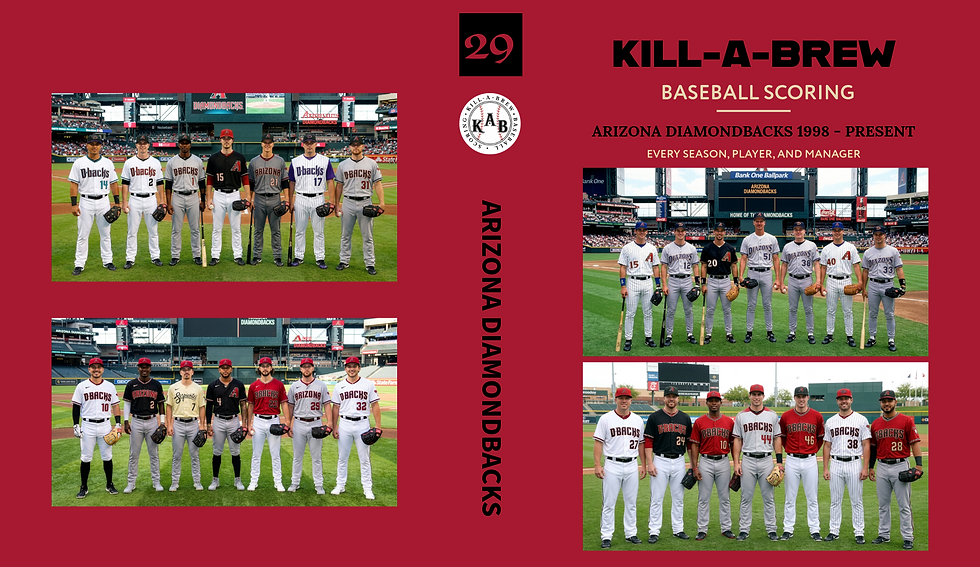
29 AZ Diamondbacks 1998 Spring 2027
30 Tampa Bay Rays 1998 Spring 2027
31 Defunct Teams 1871 2027
32 K-A-B Hall Of Fame 1871 Now
33 Era 1 1871 Now
34 Era 2 1900 2027
35 Era 3 1930 2027
36 Era 4 1960 2027
37 Era 5 1990 2027
38 Era 6 2020 2030
39 By Generation (Born) 1871 Soon
40 By Generation (Played) 1871 2027
41 YBY Awards: MVP, SS, 1871 Soon
Book Description
Every Kill-A-Brew book is
Softcover
8.5 x 11 inches
12 point font or larger so no need for reading glasses
About 500 pages and 1.6 inches thick
Weighs 4 Pounds
Paper is 80 / 32 LB. / 118 g
96 bright white
Complimentary personalized note if you choose. Example - Thank you dad for introducing me to the great game of baseball
About the Author
Hi, I’m Michael Lallas, a lifelong stats geek. I retired October 2025 and have worked 70 hours a week ever since compiling and now publishing 40 books using stats I have gathered over my lifetime. My fascination with stats started when I was eleven years old in the summer of 1975. I would read the box scores for baseball or football just about every day. I would write down the stats leaders every so often in my notebook and would work on simple formulas to grade players. I was thrilled when I first read slugging percentage stats. It didn’t seem fair to rank players by batting average because we all know a double is better than a single, a triple is better than a double and a home run is best of all. In batting average, they all count the same so slugging to me seemed a better calculation. But slugging by itself was over weighted when compared to batting average, so I added (BA + SLG)/2 = Combined Average. I later added OBP and divided it by 3 and as a preteen I had my own version of OPS nine years before John Thorn introduced it to the world in 1984. To this day total bases is my favorite baseball statistic.
My family moved from Falcon Heights to Shoreview when I was 15 years old and that notebook and a lot of other memories never made it to our new home --- it would be fun to see that old notebook again.
I started a one-man speech recognition business in 1999 as a premier partner with Dragon NaturallySpeaking. My job was to sell, train and program the software. I worked from home so with no long commute or wasted time in a busy office I once again had guilt free time between 3 and 7 am to enter stats. I made my first ever purchase on Amazon April 3, 2001, and it was Total Baseball VII. There were updated stats to 19th century players in volume VII, so I started over with data input going in alphabetical order. There was no reason I did all this work except that I wanted to find out how players ranked over the decades and discover new ones. I also wrote a “did you know” paragraph when reporting our weekly fantasy baseball results. Cap Anson was the first really big surprise. He was not known by me or any of my friends, but he had an incredible career. I thought how could such an amazing player become so unknown. This led me to cherry pick the best players and it became addictive to discover all these players I’ve never heard of before.
In 2003 Microsoft Windows XP operating system had speech recognition included for free. Even though the software did not perform well it seemed that it was just a matter of time before they would dominate speech recognition. Microsoft contacted me in the summer of 2003 to partner with me, but it seemed they were only interested in my client list. So, I posted my resume on Monster.com and to my surprise I was contacted by several financial companies. I knew nothing about finances, but I was assured that I had the aptitude to become a Financial Advisor. I started my new career in November of 2003 and retired October 22, 2025.
Training, obtaining all the required licenses to become a Financial Advisor and later a Registered Investment Advisor as well as building my business required all my attention. Life became a little more chaotic with the birth of my twins Dylan and Lola in March 2004. The next four years were a blur, and I entered no baseball stats.
In 2008 my twins turned 4 years old, and I started pitching batting practice to them with tennis balls at the park. My son would swing with all his might on every pitch ala Vladimir Guerrero Sr. and my daughter had a controlled power swing that reminded me of Harmon Killebrew. We went to the park several times a week, me pitching, the kids swinging hard, and my black lab Payton retrieving, he was a great fielder. Those were some of my favorite days. While pitching batting practice one day I was thinking about how much fun it was to watch my kids develop their baseball skills and imagine what it was like for my baseball heroes when they were kids playing baseball with their dad. It didn’t occur to me until then to wonder how long dads have been teaching their kids baseball as my dad did not teach me. I have read plenty of books about old time MLB players being taught/coached by their dad.
The next thought I had was where did baseball come from? I remembered something about Abner Doubleday inventing baseball, so I went in search of the beginnings of baseball. This is when I learned about the Mills commission of 1905. The commission was sparked by Henry Chadwick who published in 1903 that baseball evolved from rounders, a game played in England. The Baseball powers wanted to report that baseball was entirely an American invention to contradict Chadwick. Baseball released their findings on December 30, 1907, and reported that Civil War hero Abner Doubleday instantaneously and single-handedly invented baseball in 1839 while in a cow pasture in Cooperstown, NY. Without going into depth Doubleday had nothing to do with inventing baseball.
I discovered several articles online written by John Thorn. Four Fathers of Baseball (2005) was life altering for me and I proceeded to read everything I could find written by Thorn and other baseball historians. Baseball in the Garden of Eden: The Secret History of the Early Game was my first John Thorn book, besides Total Baseball, and it intrigued me more than ever to discover early baseball. I dropped the endless data entering and focused on the origins of baseball. I found informative articles by Randall Brown, Monica Nucciarone, and others. Besides Baseball In The Garden, some other of my favorite books on early baseball include The Glory of Their Times: The Story of the Early Days of Baseball Told by the Men Who Played It (Lawrence S. Ritter), Gentlemen at the Bat: A Fictional Oral History of the New York Knickerbockers and the Early Days of Base Ball (Howard Burman), When Johnny Came Sliding Home – The Post-Civil War Baseball Boom, 1965-1870 (William J. Ryczek), among others. After exhaustive study, it is my opinion that boys and girls have been playing ball and stick games since we were neanderthals and it has evolved into modern baseball.
In 2012 the stats geek in me was thrilled when I purchased The National Association of Base Ball Players, 1857-1870 Paperback – April 15, 2000, by Marshall D. Wright. The National Association of Base Ball Players was the governing body of baseball for 14 years until the first all professional league, and the birth of Major League Baseball, the National Association in 1871. The book includes all the teams that formed the National Association of Base Ball Players in 1857 including game scores and individual’s batting stats. The individual yearly stats include Position, Games Played, Hands Lost (HL), Average (A), Over (O), Runs, Average (A), Over (O). Average and Over stats were borrowed from cricket. Average and over (runs) was the average number of runs a player scored per game, expressed as a whole number and a remainder. If a player scored 31 runs in nine games, his average runs per game would be three, with four left over and would be written as 3,4. Hands Lost was the term used as outs. If a player had 21 Hands Lost (outs) in 9 games his A&O would be written 2,3.
According to Wright’s book (p.8) in 1857 a Mr. Gelston, starting catcher for the Eagle club, scored the most runs (33), played 9 games and his AO was 3,6. While L M. Bergen, the catcher for the Atlantics of Brooklyn, NY, had one of the lowest Hands Lost AO as he made 12 outs in 5 games for a 2,2. In 1868 teams started reporting a player’s Hits and Total Bases and both were written as AO. In 1870 they started using decimals as we use them today.
It was fun to see players from the National Association in Wright’s book. In 1858 Harry Wright was a pitcher and catcher for the New York Knickerbockers to start his playing career and on his way to becoming a father of baseball. Eighteen-year-old Charlie Smith played his first of thirteen seasons for the Brooklyn Atlantics in 1858 before joining the Mutuals of New York of the National Association in 1871 as a third baseman. The Chicago Cubs (White Stocking in 1871) first shortstop was 27-year-old Ed Duffy who started his career as a 16-year-old second baseman for the Eagle of New York in 1860.
Nate Berkenstock is probably the first person born to play Major League Baseball. Born September 17, 1832, in Philadelphia, Berkenstock was the cofounder of the Philadelphia Athletics on April 7, 1860, and was a power hitting first baseman for years before playing one game as the right fielder for the Athletics in 1871. What happened the year Berkenstock was born? Andrew Jackson was the president of the United States. Charles Carroll of Carrollton, the last surviving signatory of the Declaration of Independence dies at his home in Maryland at age 95. The Ordinance of Nullification is passed which set the stage for conflict during the antebellum era, eventually leading to the American Civil War.
When perfecting the calculations for players to get into the Kill-A-Brew Hall of Fame, I discovered some players enshrined at Cooperstown had KAB scores that were nowhere near good enough to make it into the KAB HOF. How could this be? I read about Frankie Frisch and how his buddies were elected to the HOF when he was the chairman of the committee on Baseball Veterans. I picked up the book Whatever Happened To The Hall Of Fame? (Bill James) and I agree with him that several inducted players have no business being in the Hall of Fame.
Calculating KAB points for Managers is simple: 2 pts per Game + 2 pts per Win + 50 pts per Pennant + 50 pts per World Series win. Most managers in the KAB HOF are in or will be in the MLB HOF except for a few that never won a World Series regardless of their high numbers of wins. There are others that won a World Series or two and have a lot of career wins, but the baseball powers decide to exclude some deserving managers. A great book in my collection is all about managers --- The Bill James Guide To Baseball Managers. This book was written in 1997, and it covers managers from the 1870s -1990s.
I don’t recall when I discovered BaseballReference.com but I used Baseball Reference to double check every stat of every player, and it took me many years to complete. All these years later and with my retirement I decided to offer the results and rankings of all MLB players using my Kill-A-Brew Baseball Scoring system in book form so that fellow stats geeks can discover a new, and I believe, better way of ranking players.
As a baseball fan I hope you find this book informative and a great reference source on the history of the great game of baseball and all its teams, players, and managers.
If you have any comments or suggestions please feel free to send me an email.
Thank you for your support,
Michael